
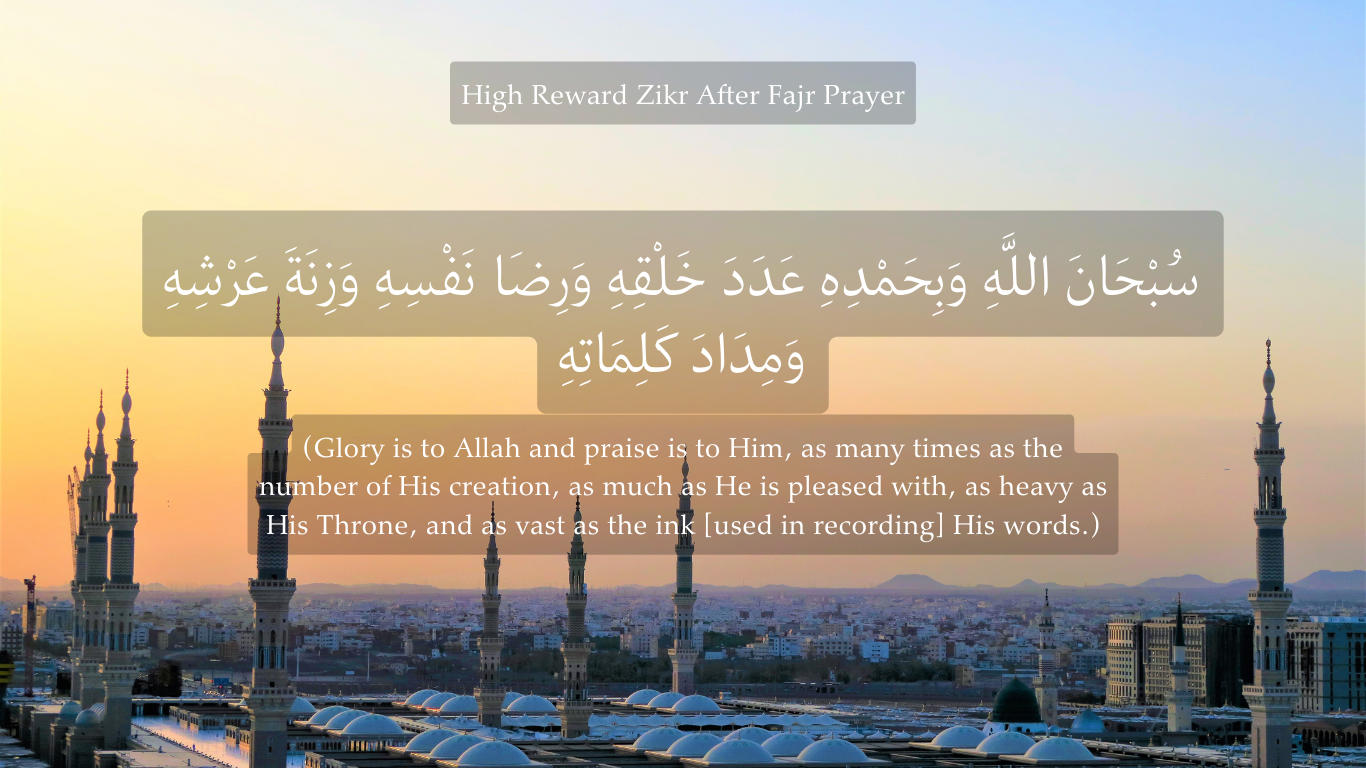
Pronunciation: Subhaanallaahi wa bihamdihi, ‘Adada khalqihi wa ridhaa nafsihi, wa zinata ‘arshihi, wa midaada kalimaatihi
Meaning: How perfect Allah is and I praise Him by the number of His creation and His pleasure, and by the weight of His throne, and the ink of His words.
Virtue: Praise of Allah equal to the number of his creation and the weight of His throne
Hadith Reference:
- Source: Sahih Muslim
- Book: Book of Remembrance, Supplication, Repentance, and Seeking Forgiveness (Kitab al-Dhikr wa al-Du’a wa al-Tawba wa al-Istighfar)
- Hadith Number: 2726 (Sahih Muslim 2726)
- Narrator: Juwayriyyah bint al-Harith (رضي الله عنها)
Hadith Text (Arabic & English Translation):
Juwayriyyah bint al-Harith (رضي الله عنها) reported:
The Prophet (ﷺ) came out from my apartment in the morning as I was busy in performing the dawn prayer. He came back in the forenoon and found me sitting there. He said:
“Have you been sitting here since I left you?”
I said: “Yes.”
Thereupon, the Prophet (ﷺ) said:“I recited four phrases three times after I left you. If these were weighed against what you have recited since morning, these would be heavier:
Subḥānallāhi wa biḥamdihi, ‘adada khalqihi, wa riḍā nafsihi, wa zinata ‘arshihi, wa midāda kalimātihi.”
(Glory is to Allah and praise is to Him, as many times as the number of His creation, as much as He is pleased with, as heavy as His Throne, and as vast as the ink [used in recording] His words.)
Classification:
- Sahih (Authentic)
- Reported in Sahih Muslim (Hadith 2726)
- Also mentioned in Riyad as-Salihin (Hadith 1436)
This Hadith highlights the immense reward of this dhikr and how brief yet powerful it is in comparison to prolonged recitation.